

Australia’s rapidly growing renewable energy and storage footprint has insulated the country from global geopolitical disruptions.
This is the view of the CSIRO, which through its GenCost 2025–26 report, has detailed the most up-to-date cost projections involved with building and operating Australia’s electricity generation, storage and hydrogen infrastructure.
The report, which follows on from the draft report released in December 2025, expects electricity generation costs to continue falling in the near term as battery storage costs reduce and capacity expands. This supports the argument that combining renewable energy and storage provides the lowest cost pathway for Australia’s electricity system to achieve net-zero emissions.
Other key findings:
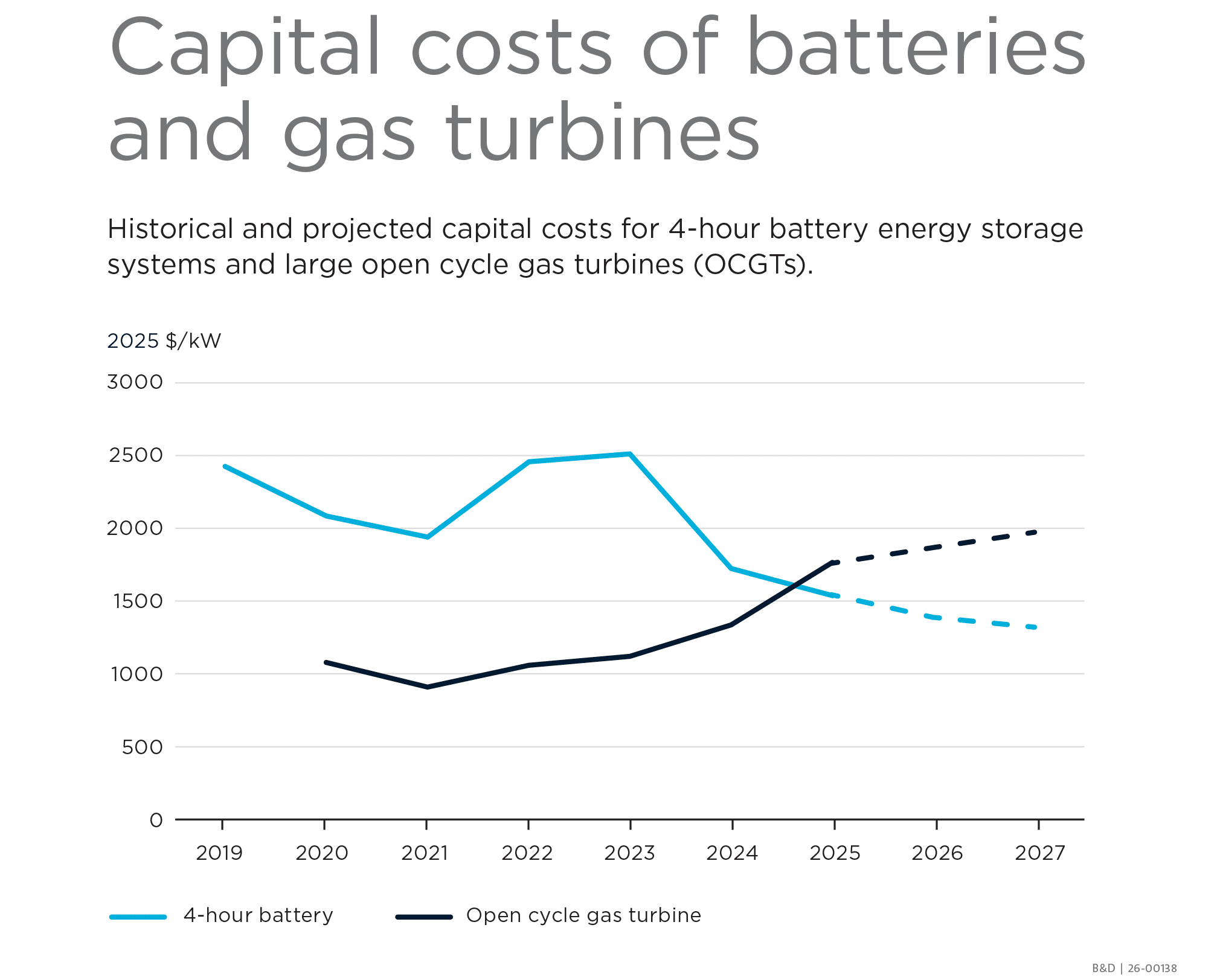
- Fossil-fuel costs rise:Rising demand for gas turbines to power US data centres is increasing costs for gas-based technologies.
- Short-term costs:Growing capacity of lower cost batteries capacity is beginning to reshape electricity markets, competing with traditional gas peaking generation and contributing to lower evening peak prices.
- Long-term costs: By 2050, all new electricity generation technologies are projected to cost more than $100 per megawatt-hour (MWh) as ageing assets are replaced across the system.
GenCost 2025–26 found the average National Electricity Market (NEM) generation price reached approximately $104/MWh in 2025, down from a peak of $189/MWh in 2022. Electricity futures prices suggest this figure could fall further to between $80 and $90/MWh by 2030.
CSIRO chief energy economist and GenCost project leader Paul Graham said it was critical the report was developed with the global geopolitical backdrop in mind.
“Each year GenCost, with the help of stakeholders, seeks to understand how electricity technology markets are changing,” he said. “The impacts of the Iran war and data-centre demand for gas turbines are currently the strongest drivers of uncertainty.”
“This year’s report incorporates extensive stakeholder feedback, including new use of market data for near-term projections and open-source modelling tools that improve transparency, enabling industry and researchers to engage more deeply with our results.”
GenCost 2025–26 suggests gas technologies will play a limited but important role in helping firm the electricity system, contributing around three to seven per cent of generation by 2050.
The report also finds that while some non-renewable technologies, such as new black coal, are potentially cost-competitive with renewables, their use would require higher cost carbon abatement elsewhere in the economy to achieve Australia’s net-zero goals.
GenCost also outlines how the data-centre sector has become a primary demand driver. According to the International Energy Agency, US data centres are now among the world’s largest sources of gas turbine demand, contributing to sustained global cost increases.
The report finds solar and onshore wind will remain the backbone of a least-cost future electricity system, supplying 93 per cent of Australia’s electricity by 2050. This would be supported by hydro, storage, transmission and flexible generation such as gas and hydrogen.