

Bentley Systems helped SA Power Networks cut rework and save 100 work hours relocating infrastructure for the Hillside mine.
Bentley Systems is globally recognised for its ability to develop bespoke software for contractors, engineers and owner-operators working at the coal face of infrastructure projects.
The software pioneer has inspired many transmission and distribution projects in Australia, with the lion’s share of developers using the Power Line Systems (PLS) product suite to deliver accurate, compliant, and cost-effective powerline designs.
For SA Power Networks, PLS-CADD – an end-to-end engineering design and drafting tool for overhead power lines – has been indispensable to its commitment to delivering safe and reliable power for 1.7 million people in South Australia.
“PLS-CADD usage is, if anything, growing in the organisation,” SA Power Networks CAD specialist Leigh Menzel told Energy.
“We’re using it extensively to support new solar farms and wind farms in remote locations, battery energy storage systems (BESS) near those sites, and new data centres co-located where there’s plenty of power, land, and water.
“We’re using PLS-CADD for the design work to connect all of these assets.”
One project where PLS-CADD has proven particularly effective is at the Hillside copper-gold project, which called on SA Power Networks to carry out a network relocation to support its proposed mining operations.
The project team was tasked with selecting a new road alignment, designing new overhead line configurations, and ensuring all assets met clearance, safety, and regulatory requirements.
By moving network assets out of the mine footprint, the goal was to minimise disruption to customers, reduce construction risk, and deliver a future-ready network configuration.
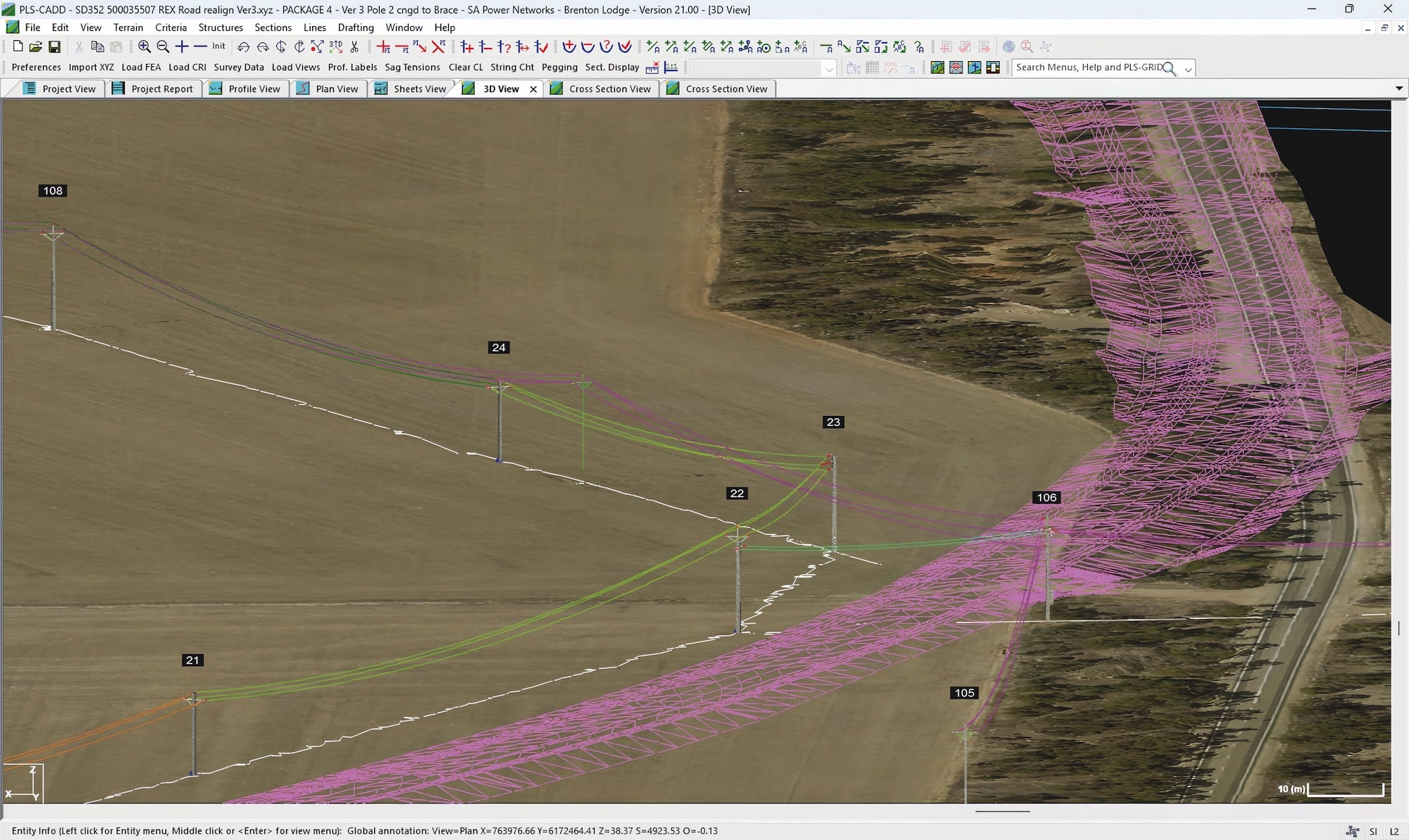
The design of the network relocation was interfaced in PLS-CADD.
“PLS-CADD was an obvious choice for this project,” Menzel said. “It offers a full suite of capabilities across the powerline design envelope.
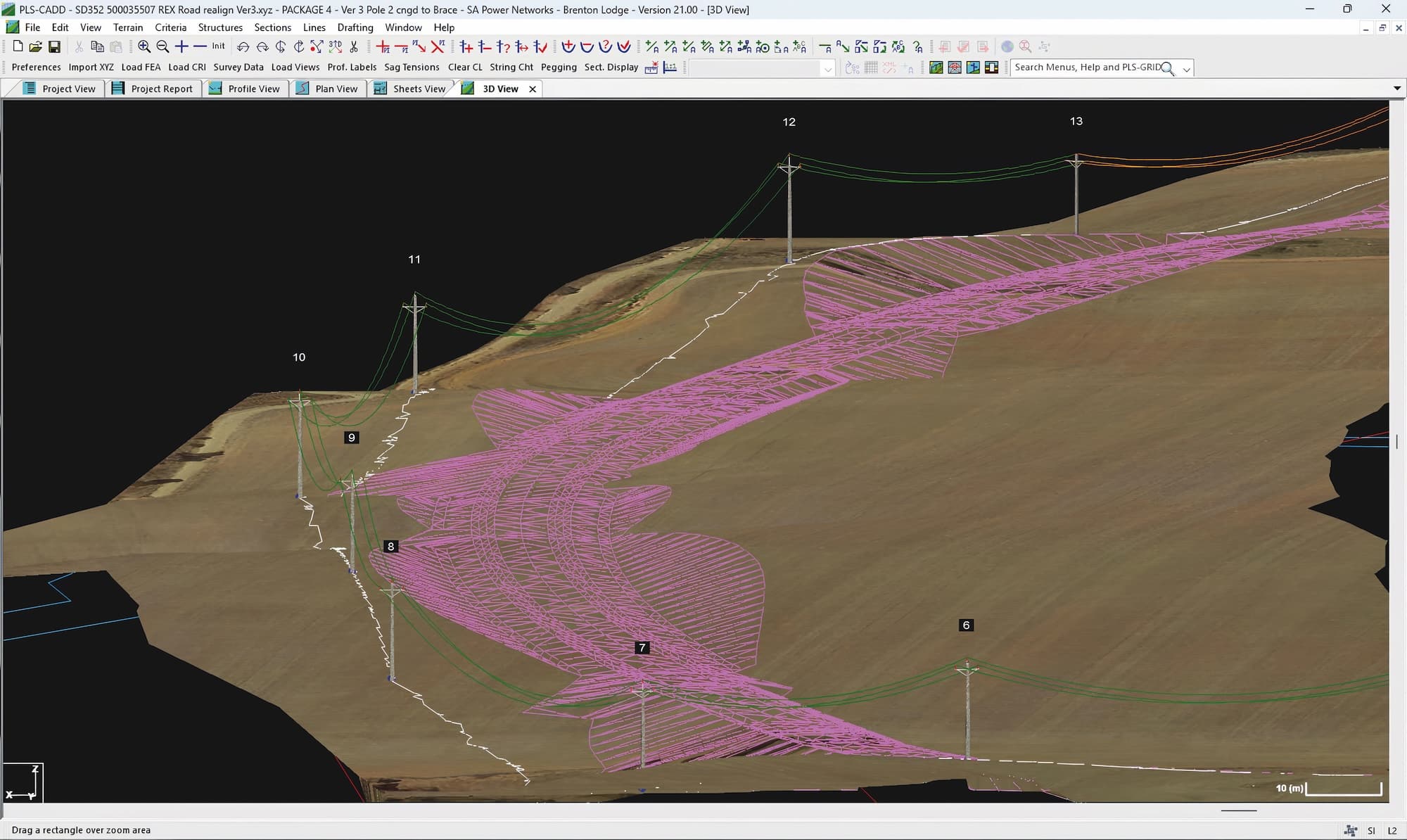
“We used Bentley’s PLS-CADD as a single platform for line modelling and reporting. It helped confirm pole strength and strain capabilities, model the catenary sag of conductors, and check line clearances and compliance.
“We’ve used PLS-CADD for a long time for these types of overhead line design tasks, so continuing to use it on this project was a no‑brainer.”
Menzel said PLS-CADD meets all of SA Power Networks’ desired design requirements.
“Over the years, PLS-CADD has proven to be the best solution for what we do,” he said. “While there are many tools that do individual aspects like PLS-CADD, having a single product that covers the breadth of our needs is important.
“It’s also cost-effective and easy to support from an IT perspective: one product doing many things, rather than 15 products doing different things and may not integrate nicely.”
The vision was already set
SA Power Networks was given a headstart on the Hillside network relocation project, with the mine owner already creating its own digital terrain model (DTM) of the site.
This is distinct from other SA Power Networks projects.
“We would normally send a survey team out to measure site conditions such as road levels, terrain, etc., and we’d then estimate where everything would be once the civil works were done and design around that,” Menzel said. “Inevitably, there are changes or our best guesses turn out to be slightly wrong, and we would then have to move things around.
“What was different on this occasion, and something we’d like to see more of, is that the mine owner had already developed a digital terrain model.”
The DTM allowed SA Power Networks to design, to relatively accuracy, the expected reduced levels (RLs) of the finished civil design rather than guessing.
“That was the exciting part for us,” Menzel said. “We could model everything in 3D, show where the assets would go, check clearances, and confirm compliance.
“Having this data upfront was worth its weight in gold.”
By using the pre-established DTM, the network could be designed against the mine’s future. This provided early confidence on clearance and constructability, cut rework, and saved an estimated 100 work hours against the project’s 1400 total hours.
Bentley’s broader capability
PLS-CADD forms a central cog of Bentley Systems’ Power Line Systems portfolio, which also comprises PLS-GRID, PLS-POLE, TOWER, SAPS and CAISSON.
As Bentley Systems senior regional director – Australia and New Zealand Vivek Kumar explained, the greatest benefits are realised when PLS is paired with Bentley’s broader product suite, such as MicroStation, iTwin and Bentley Infrastructure Cloud.
“Through our iTwin platform, users can export an infrastructure digital twin,” he told Energy.
“This pulls together insights and designs from adjacent platforms, such as PLS for powerline design, MicroStation for designing other assets and Bentley Infrastructure Cloud, to create shared iTwin models across different parts of the supply chain.
“These models can engage with one another to create an end-to-end vision of an operation.”
From initial design to construction, commissioning and operations, Bentley helps end users right across the project workflow. This is particularly important when rationalising past, present and future data.
“End users want to be able to take data from the initial design stage to operations and maintenance without losing asset attributes and tags,” Kumar said.
“Together, PLS, MicroStation and Bentley Infrastructure Cloud can provide an AI‑ready schema for you down the track, so when design and construction is complete, end users can access the same asset data that was there from the original design.
“This makes it easy to search contextual information based on existing metadata, which is essential to the organisation of a project.”
Kumar said PLS is used to support 80–90 per cent of distribution and transmission design in Australia’s electricity sector.
As Bentley expands its Australian footprint further, it’s seeking to influence the supply chain early.
“We’re engaging with the market, holding events and information sessions, with the goal of saying, ‘If you use our software, and this is how you mandate it in your tenders, for example, you can achieve a much better outcome across your project lifecycle’,” Kumar said.
“We’re actively working with the lion’s share of transmission and distribution projects across Australia, so I’d say this strategy is starting to pay off.”